

As AI continues to advance, many organizations may feel pressure to introduce the technology as quickly as possible. Leadership may purchase an AI system, provide employees with a short demonstration, and expect them to begin identifying ways to use it.
For a few low-risk applications, this approach may work. However, what happens when employees need to use AI for sensitive information, detailed analysis, customer recommendations, software development, or other consequential work?
Proper AI use requires more than technical knowledge of a particular tool. For instance, employees may need to reconsider how they approach their work, how they protect information, and how they evaluate the quality of their results. They must also learn when AI belongs in a process, when it does not, and when a specialist needs to step in.
To prepare employees properly, organizations should consider AI education a complete onboarding process rather than a one-time orientation.
Begin Before the First Workshop
Indeed’s virtual onboarding guide recommends preparing the necessary technology, creating a clear agenda, providing practical resources, and assigning ongoing points of contact. Although this guidance does not address AI specifically, these practices can also help organizations create a more manageable AI onboarding process. Indeed also recommends spreading training across a week or longer so that employees do not receive too much information at once.
To effectively create their own onboarding guide, leadership should first explain why the organization is adopting AI, how the technology may support employees, and what the organization hopes to accomplish.
This discussion can also address some of the questions employees may already have:
Will AI change their responsibilities?
How will leadership evaluate their AI use?
What happens if the system produces an incorrect response?
Where can they raise concerns?
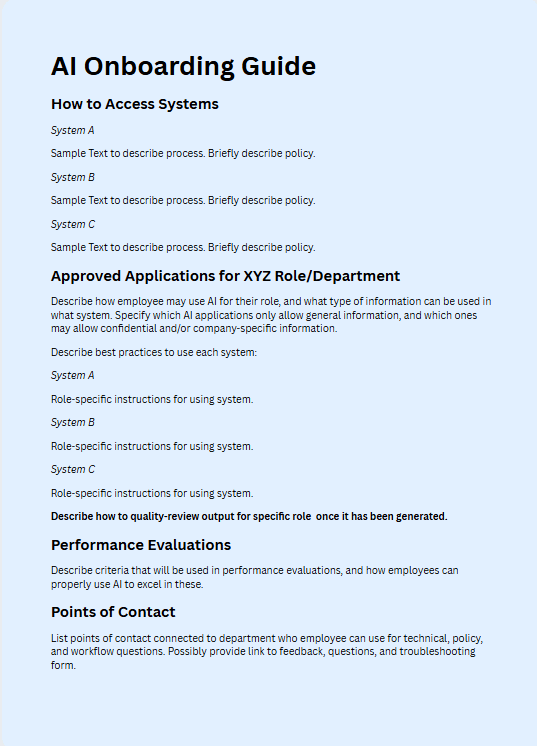
From there, employees should receive an onboarding guide for each approved AI system. This guide may include the following:
- Instructions for accessing and setting up the system
- The policy governing that particular system
- Information employees may and may not enter
- Approved applications for each role or department
- Role-specific instructions for using the system
- The required review process for AI-generated outputs
- Points of contact for technical, policy, and workflow questions
- An explanation of how responsible AI use will be considered during performance evaluations
The image to the right provides a possible way to format this onboarding guide.
Organizations can provide videos for straightforward setup instructions. They may also schedule a live setup meeting for employees who need additional assistance or will use more complex systems.
Connect Workshops With Employees’ Responsibilities
 General AI training can introduce employees to the technology. However, it may not show them how AI fits into their daily responsibilities.
For instance, administrative employees might learn to use AI to summarize meetings, organize documentation, or prepare first drafts of internal communications. Project coordinators could use AI to develop status-report templates, identify project risks, or organize action items. Marketing employees may explore brainstorming and content development, while developers could focus on code assistance and testing.
By connecting workshops with familiar responsibilities, organizations can make AI feel more practical and less intimidating. This approach also helps employees identify where the technology may improve their work and where human oversight remains necessary.
The workshop should cover the complete workflow, not only the prompt. Before using AI, employees should define the problem, audience, constraints, risks, and intended outcome. After receiving a response, they should review the information, verify important claims, and revise the result using their professional knowledge.
Hands-on workshops become especially important when employees will work with sensitive information or extensive analysis. For example, employees could review sample prompts and determine whether the information is safe to enter, should be anonymized, or requires a more secure system. They could also evaluate an AI-generated report containing an unsupported claim, outdated information, or a misleading conclusion.
These exercises give employees an opportunity to make and correct mistakes before those mistakes affect customers, internal systems, or business decisions.
Ask Employees to Help Shape the Program
Unfortunately, leadership and technical teams may not recognize every concern that employees will encounter. However, they can mitigate this risk by seeking employee feedback.
A 2025 Frontiers study used a participatory process to create an HR-led employee-wellbeing program. First, the researchers identified 25 evidence-based topics. They then introduced those topics during a pilot workshop and held a structured focus-group discussion. Employees reflected on the material, identified the topics they found most valuable, and helped shape the final program.
Organizations could apply a similar process to AI onboarding:
- Identify essential topics through research and a risk review.
- Select a pilot group with different roles, backgrounds, and levels of AI experience.
- Conduct an initial workshop.
- Ask employees what felt useful, confusing, concerning, or unrealistic.
- Refine the program and test it again.
Of course, employee preferences should not override required security, legal, or compliance topics. However, their input can reveal practical concerns and limitations that leadership may otherwise overlook.
Teach Employees to Evaluate AI Outputs
As frequently demonstrated, AI can produce a polished response that still contains inaccurate or misleading information.
Because of this, employees should learn to identify hallucinations, unsupported claims, bias, outdated information, logical inconsistencies, and missing organizational context. They should also understand that the appropriate review process will depend on the risk involved.
| Level of risk | Example | Recommended review |
|---|---|---|
| Lower | Brainstorming or an internal outline | Employee editorial review |
| Moderate | External content or operational documentation | Source checks and manager or peer review |
| Higher | Financial analysis, legal information, code, or customer recommendations | Testing, documented verification, and specialist approval |
For a deeper breakdown of this risk level approach to review, please take a look at our previously published article.
Performance evaluations should follow a similar approach. Rather than rewarding employees for using AI as frequently as possible, managers can evaluate whether employees select appropriate use cases, protect sensitive information, verify important outputs, document consequential workflows, and continue to exercise independent judgment. In some situations, an employee’s decision not to use AI may demonstrate the better judgment.
Continue Onboarding Beyond the Workshop
 Even a well-developed workshop cannot prepare employees for every situation they may encounter. For instance, some questions will only emerge once employees begin applying AI to their daily responsibilities. For this reason, organizations should view the workshop as the beginning of the onboarding process rather than its conclusion.
After the initial training, employees need opportunities to practice, ask questions, receive feedback, and gradually take on more complex applications. Leadership must also consider an important question:
How will the organization know whether the onboarding process worked?
Smartsheet’s onboarding resources recommend assigning owners, deadlines, status updates, and notes to activities that continue from preboarding through an employee’s first 90 days. Organizations can adapt this structure to create a clear progression for AI onboarding and prevent the program from ending after one workshop:
During the first 30 days, employees might complete foundational policy and security training, practice with low-risk examples, and meet with an AI champion or manager to discuss questions. By 60 days, they should be able to demonstrate approved AI-supported workflows under supervision. By 90 days, employees should be able to fully determine when AI is appropriate, evaluate its output, protect sensitive information, and explain the reasoning behind their decisions.
These milestones also give leadership a more meaningful way to evaluate the program. Workshop attendance and assessment scores may show whether employees completed the initial requirements, but they do not necessarily show whether employees can apply the information responsibly.
A recently published cybersecurity-training research article recommends combining baseline assessments and role-based education with behavioral measurements, leadership involvement, learning-management systems, and continuous updates. These principles apply well to AI because both areas require organizations to monitor what employees actually do rather than only whether they completed a course.
With ongoing check-ins, practical assessments, and employee feedback, leadership can identify where the onboarding program is working and where employees need additional guidance. As AI systems, policies, and organizational needs change, the program can then continue to change alongside them.
Connect AI Education With Employee Growth
Finally, organizations should help employees understand where their AI education may lead.
Some employees may become AI champions, trainers, quality reviewers, system administrators, or governance representatives. Others could develop related skills in data analysis, project coordination, cybersecurity, process improvement, or workflow automation.
These pathways do not require every employee to become a programmer or data scientist. In many cases, the strongest approach will combine new technical skills with the employee’s existing business knowledge, interpersonal abilities, and professional experience. However, organizations should formally recognize and support these new responsibilities, and give employees opportunities for growth. (We will discuss this in more detail in our next article. Stay tuned!)
Ultimately, AI onboarding should accomplish more than teaching employees how to operate a tool. A well-developed program can help employees evaluate AI, protect organizational information, improve processes, and prepare for new responsibilities. When employees understand how AI education connects with their daily work and future career opportunities, adoption may feel less like a threat and more like an opportunity to grow.
This article is part of a series on how AI will impact the workforce. For more insights on this topic, feel free to review our other articles:
What Will AI Adoption Ask of Your Workforce? – Innovate. Integrate. Transform. Run. R3Now dba IITRun




Leave A Comment