

“Learning without thought is labor lost; thought without learning is perilous.” ~Confucius
Today, we continue to see Confucius’s insights reflect in the current AI industrial shift. Artificial intelligence carries more information in its systems than a single person could learn in a lifetime, but unless an organization thinks through the information provided, they stand at risk.
As organizations adopt AI, one of the most important questions is not simply where the technology can be used. Leaders also need to determine an AI framework, considering how employees should use AI and how much human oversight different tasks require.
On Wednesday, we discussed model collapse and how a similar cycle can occur inside an organization. Marketing teams may create an echo chamber by repeatedly building on AI-generated messaging. Technical teams may apply the same solutions to different projects without considering their specific needs. Developers may generate poor-quality code that creates long-term maintenance problems. Employees may also repeat familiar band-aid fixes rather than investigating the underlying cause.
Avoiding these outcomes does not require organizations to limit AI to a handful of basic tasks. Instead, they need a clear workflow that helps employees use AI efficiently while retaining appropriate human judgment and accountability.
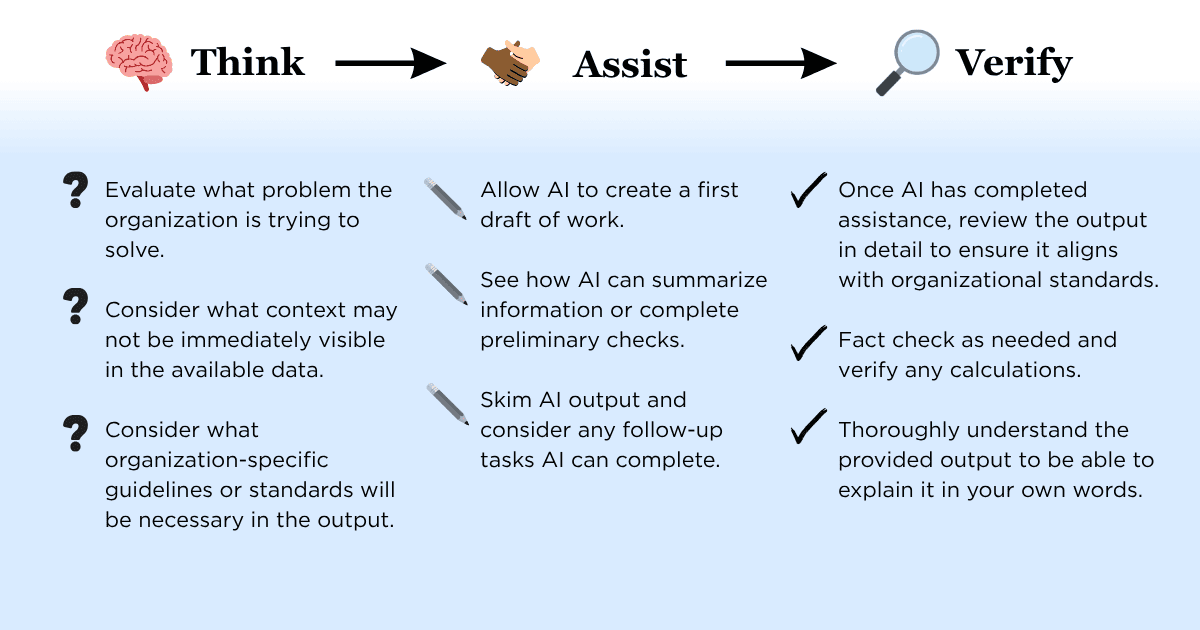
Below, we explore a possible approach:
The Think, Assist, Verify Framework
Think
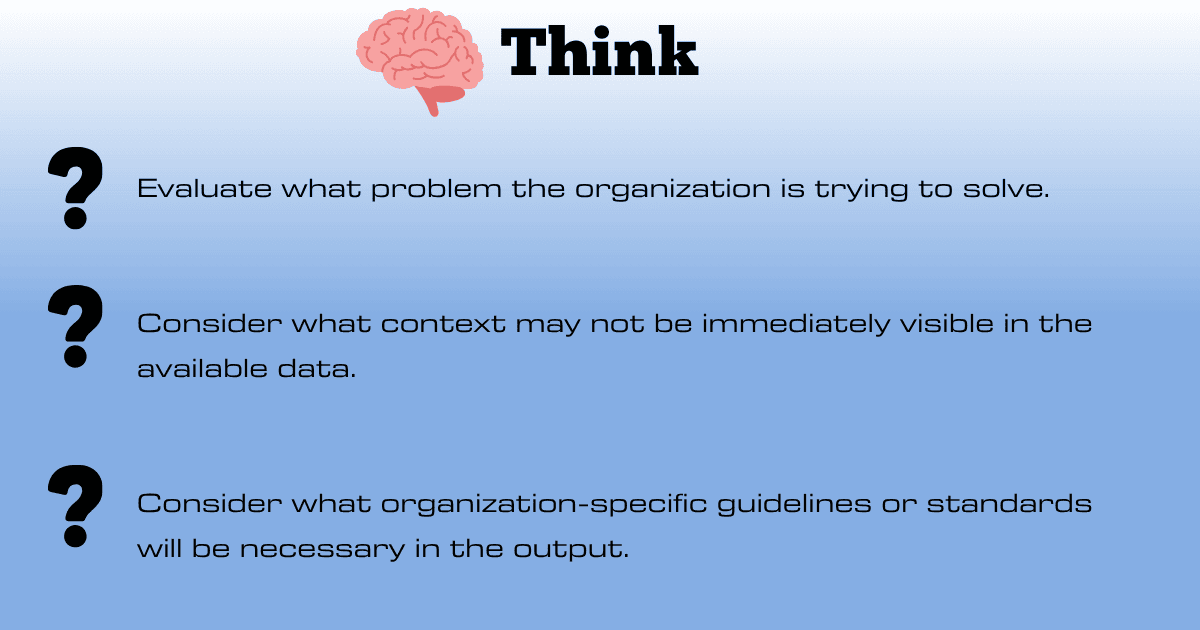
Before using AI, employees need to define their objectives:
What problem am I trying to solve?
What have I observed that may not appear in the available data?
What organizational standards, customer expectations, or unusual circumstances need to be considered?
This step does not need to become a lengthy planning exercise. The employee simply needs to begin with a clear understanding of the task, rather than allowing the AI to define the direction.
AI can produce an answer, but it cannot define every worthwhile question. In reality, it more closely resembles a word calculator than a genuine intelligence. Unlike AI, employees contribute knowledge of customers, internal operations, organizational goals, past experiences, and industry-specific requirements. That context shapes what the employee asks AI to do and how useful the response will ultimately be.
For instance, after noticing a consistent lack of response to a customer communication, an employee might initially ask AI to rewrite the communication for clarity. However, the employee may later realize that customers actually do understand the wording, but struggle with the underlying process. Recognizing this changes the objective from polishing a message to improving how the organization explains or delivers the process.
Assist
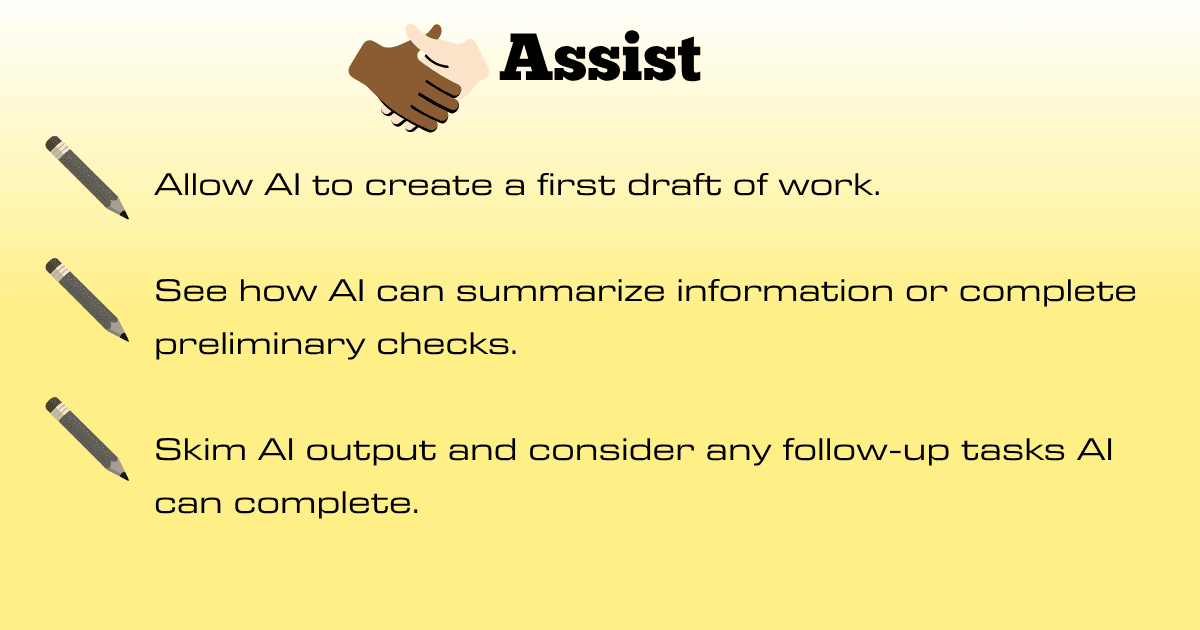
After defining the objective, the employee can use AI to expand or accelerate the work.
Depending on the task, AI might organize notes, summarize documents, suggest alternatives, create a first draft, perform a preliminary calculation, or review material for possible inconsistencies. The employee can then skim the response and determine whether AI could complete any helpful follow-up tasks.
For example, after generating a draft, an employee might ask AI to compare it against internal guidelines, identify unanswered questions, or adapt it for a different audience. This allows AI to contribute throughout the process without automatically becoming the final decision-maker.
The Assist stage is where organizations gain much of AI’s efficiency. However, the value comes from applying that efficiency to a clearly defined objective. Producing work more quickly is useful only when the work addresses the correct problem.
 Verify
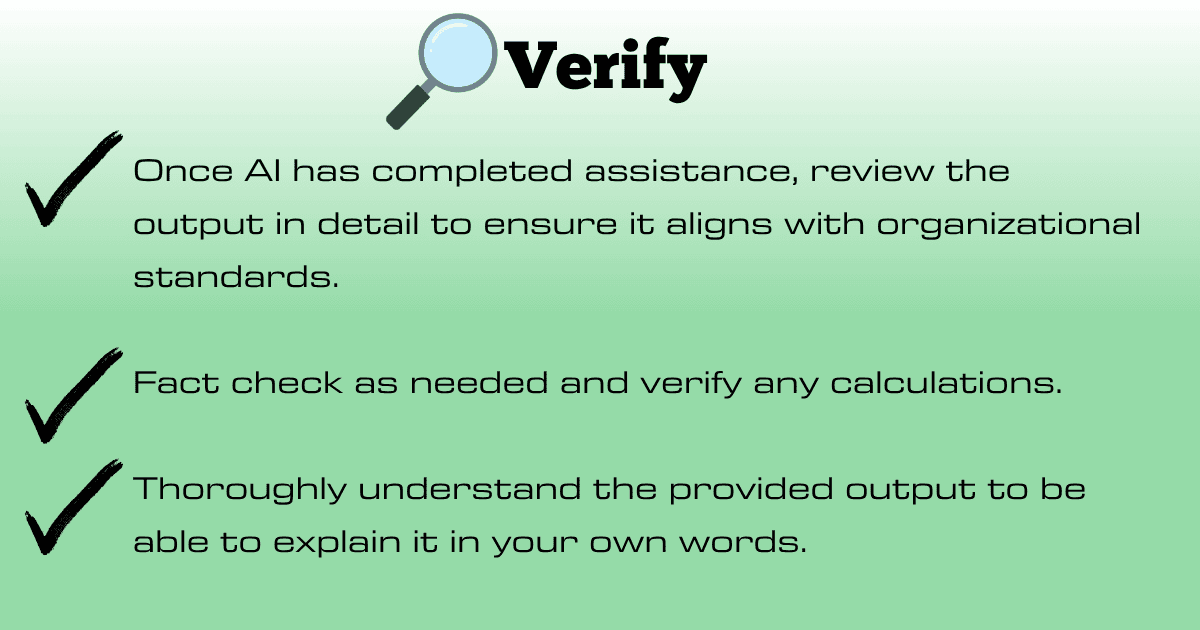
Once AI has completed its portion of the task, the employee should review the result closely for possible errors or misleading output.
Verification may include checking facts, confirming calculations, reviewing sources, testing code, assessing security concerns, and ensuring the output follows organizational or professional standards. Employees should also review whether the response actually fits the intended audience and circumstances.
The employee approving the work must understand the result well enough to explain it in their own words. This is particularly important when AI contributes to analysis or recommendations. For instance, a polished response may still rely on incomplete information, questionable assumptions, or reasoning that does not apply to the organization.
Verification therefore goes beyond proofreading. At this stage, users must apply professional judgment and human accountability.
Applying the AI Framework at Different Risk Levels
Think, Assist, Verify can be used across an organization, but it should not look identical for every task. The level of oversight should increase with the potential consequences of an error.

Lower-Risk Work
Lower-risk uses in the AI framework may include brainstorming, meeting summaries, and internal outlines.
- During the Think stage, the employee identifies the topic, audience, and desired result.
- During Assist, AI generates possibilities, organizes information, or drafts a basic structure.
- During Verify, the employee selects the useful ideas, corrects missing context, and removes inaccurate or irrelevant information.
For these tasks, verification may be relatively brief. If AI leaves out part of a meeting discussion or suggests an impractical idea during brainstorming, the employee can usually correct it before the output causes significant harm.
Even so, some review remains necessary. Otherwise, an organization may gradually fill its internal materials with inaccurate summaries, repetitive ideas, or assumptions that no one has challenged.
 Moderate-Risk Work
 Moderate-Risk Work
Moderate-risk uses may include marketing drafts, customer communications, business reports, and routine code.
- The Think stage should include a clearer definition of requirements. An employee may need to identify brand guidelines, customer expectations, reporting standards, security requirements, or the systems that could be affected.
- During Assist, AI can create a draft, recommend alternatives, or conduct a preliminary review.
- During Verify, the employee should examine claims, tone, logic, accuracy, privacy, and security. Code should be tested, customer-facing information should be confirmed, and marketing statements should be reviewed for unsupported claims.
The employee’s professional experience becomes especially important at this level of the AI framework. AI may produce work that appears complete, but does not reflect the organization’s voice, guidelines, customer relationships, or technical environment.
 Higher-Risk Work
 Higher-Risk Work
Higher-risk uses may include financial analysis, legal or medical research, and production systems.
- During the Think stage, the organization should clearly establish the question, available evidence, applicable standards, and limits of AI’s role. They may consider doing a back and forth before the actual prompt, asking the AI to let the user know if the information is complete and if any clarity is needed. Additionally, the organization may provide a detailed template of baseline information that the employee always needs to provide.
- During Assist, AI may help compare information, identify possible considerations, summarize source material, or conduct preliminary checks.
- The Verify stage must be more rigorous. Qualified professionals should review the work, verify sources and calculations, test important assumptions, and approve the final decision. Organizations may also need documented review procedures or additional approvals depending on the task.
At this level, AI should support expert judgment rather than replace it. The person responsible for the final work must be able to explain and defend the conclusion without relying on the AI response as the sole justification.
Building a More Consistent Approach to AI
Think, Assist, Verify gives organizations a common AI framework without requiring every AI use case to follow the same approval process. Employees can move quickly when the risk is low, while applying stronger controls when mistakes could affect customers, finances, compliance, security, or critical operations.
For the AI framework to work properly, employees still need training, room for independent thought, and clear accountability. Leaders must also establish what lower, moderate, and higher risk mean within their own organization. We will explore those leadership responsibilities in more detail in an upcoming article.
AI adoption should increase an organization’s capacity for original and valuable work, not merely increase the volume of generated work. By teaching employees to think first, use AI purposefully, and verify according to risk, organizations can gain efficiency without giving up the judgment that makes the work useful.



Leave A Comment