

 Today, much of the AI conversation centers on agents and rapid software development. These tools may complete repetitive tasks, prepare documentation, track progress, generate test scripts, or help organizations deliver software faster and at a lower cost.
Those applications are valuable, but they may represent only an early stage of the AI industrial shift.
Organizations have spent decades looking for ways to reduce technology costs and accelerate delivery. They have adopted new development methods, moved work offshore, automated testing, and introduced low-code tools. AI agents and natural-language development may be the latest step in this progression. They could make software automation available to more employees and allow organizations to coordinate increasingly complex workflows.
However, the larger opportunity may involve applying AI-supported knowledge and analysis across professional and technical fields. As AI capabilities improve through this process, many industries will likely undergo significant change and potentially upheaval:
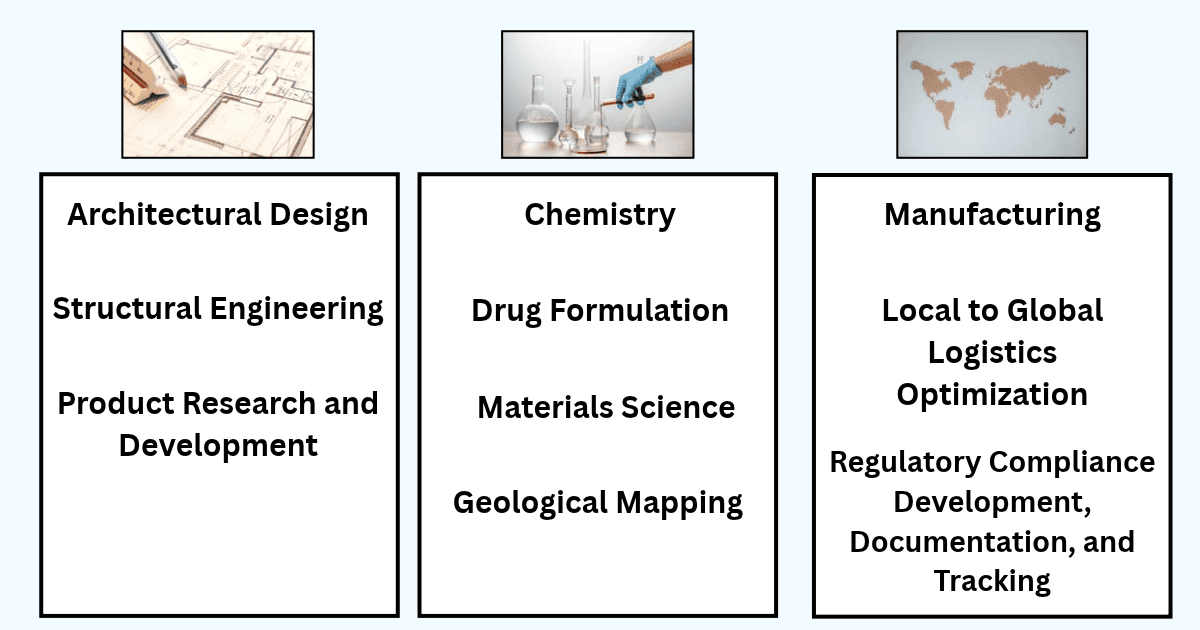
Instead of only automating routine administrative work, AI may help professionals evaluate possible materials, identify patterns, compare designs, analyze regulations, develop hypotheses, or model complicated operating conditions. This raises a vital question:
How should CEOs prepare their workforce for that future?
Look Beyond Today’s Automation Opportunities
Organizations can already apply AI to numerous activities within a large technology project. For instance, AI may help teams prepare the following:
- Business requirements
- Functional specifications
- Technical documentation
- Test plans
- Training materials
- User guides
- Status reports
- Translations
- Work instructions
AI may also compare alternatives, summarize progress, or generate test scripts from approved specifications.
Over time, multiple AI agents could coordinate portions of this work. One agent might analyze requirements, while another could prepare documentation, while another might check whether testing covers those requirements. MIT Technology Review identifies this type of agent orchestration as an important emerging development, with networks of AI agents working together on more complicated tasks.
Employees will therefore need to do more than write prompts — namely, create a streamlined process. To ensure a successful workflow, they may need to define the overall objective, divide work appropriately, establish what information each agent may access, and determine where human approval is required. They must also recognize when one agent’s mistake has been passed into the rest of the workflow.
For a more complex orchestration, employees may complete the following process:
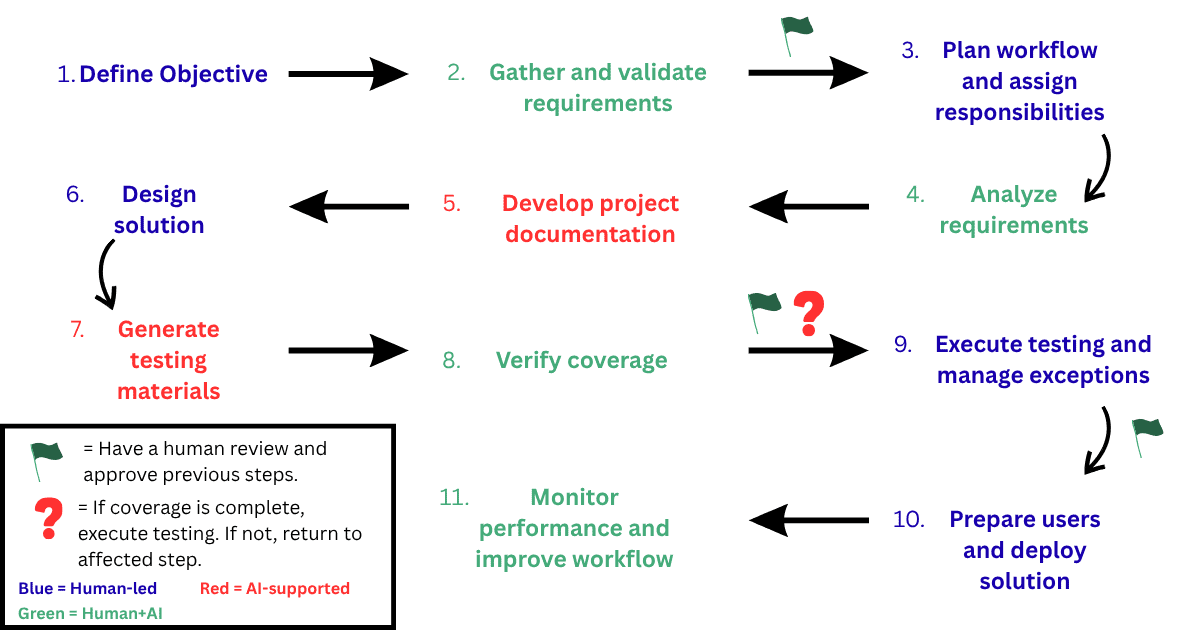
These responsibilities depend on process knowledge and judgment. An employee who does not understand how the work should be completed will struggle to determine whether an agent completed it correctly.
Prepare Professionals to Work Alongside AI Knowledge
AI-supported knowledge work could create even greater changes. For example, researchers are developing systems that can help propose scientific hypotheses, design experiments, review research, and analyze results. MIT Technology Review describes the emergence of “artificial scientists” that could work alongside human researchers as increasingly capable collaborators.
Similar changes could reach many other industries:
An engineering system might compare structural designs, but still require a professional to understand safety requirements and unusual site conditions.
An AI application could help analyze regulatory obligations, but a compliance specialist must determine which requirements apply and whether the supporting evidence will withstand an audit.
A geological system might identify promising mineral deposits, while experienced professionals evaluate the surrounding land, extraction conditions, environmental risks, and reliability of the underlying data.
In its current state, AI may generate an answer, but organizations will still need people who can determine whether it is the right answer to the right question. In other words, industry knowledge remains vital. Employees must understand customers, operating processes, regulations, risks, and unusual circumstances well enough to identify worthwhile applications. They should be able to recognize missing information, question assumptions, and explain why a recommendation should or should not be followed.
 Protect the Development of Junior Professionals
The AI industrial shift poses a difficult workforce-development question: If AI completes many traditional entry-level tasks, how will newer employees gain the experience required to become tomorrow’s specialists?
If this issue is approached incorrectly, an organization could increase its output today while quietly weakening the expertise it will need tomorrow.
Junior professionals often learn through foundational work. They prepare initial documentation, review records, conduct basic research, observe experienced colleagues, and gradually take responsibility for more complicated decisions. Some of these activities are repetitive, but they also expose employees to the details and exceptions that shape professional judgment.
Organizations do not need to preserve inefficient work simply because it has always existed. However, they should replace incidental learning with intentional development.
Junior employees could first outline how they would approach a problem before reviewing an AI recommendation. Then, they could compare multiple AI-generated answers, identify weaknesses, and explain which one they would select. They might complete supervised projects, participate in process reviews, observe specialists handling unusual cases, and gradually assume greater responsibility as they demonstrate their knowledge.
Mentorship will also become more important. Experienced professionals can help junior employees understand why certain decisions were made, which warning signs deserve attention, and when the standard process should not be followed.
Develop Skills That Will Transfer Across AI Systems
Because AI tools will continue to change, training employees on one application will not be enough. McKinsey argues that lasting advantage comes from building organizational capabilities rather than relying on technology that competitors can also obtain. It describes the ability to “learn, unlearn, and relearn” as an increasingly important part of AI transformation.
Several transferable skills may be especially valuable for junior professionals:
- Written communication: Employees should be able to describe a problem, document decisions, and communicate requirements precisely.
- Discovery and questioning: Employees must know how to ask follow-up questions, clarify unclear requests, and uncover missing context before asking AI to act.
- Process thinking: Employees should understand the inputs, process steps, outputs, responsibilities, and controls surrounding their work.
- Reasoning: Employees need to compare alternatives, identify assumptions, and explain why a conclusion is appropriate.
- Organization: Employees must be able to arrange information logically and maintain reliable documentation as AI produces larger amounts of content.
- Continuous learning: Employees should be prepared to test new tools, update their knowledge, and adapt as responsibilities change.
These abilities help employees use current AI systems, but they also prepare them for whatever comes next.
Preserve the Reasoning Behind the Work
Strong documentation will be particularly important in the AI industrial shift. AI can produce a polished result so quickly that teams may overlook the thinking that should come first.
After rebuilding his design process around AI, product leader Dan Maccarone found that his team did not necessarily finish its sprints faster. Instead, the process could produce a more complete result within the same period. He also identified a less visible risk: If an AI-generated prototype becomes the specification, the organization may eventually lose the reasoning behind important design decisions. His team addressed this by documenting the problem, intended user, desired outcome, relevant scenarios, and success measures before using AI.
Organizations can apply the same principle beyond design. Before employees use AI, they should understand what they are trying to accomplish and why. Afterward, they should verify the result and record important decisions. This preserves organizational knowledge and makes future review possible.
 Help Existing Employees Adapt
Not every employee will approach AI with the same confidence. Some may be enthusiastic, while others may worry about job security, professional standards, or the effect on customers.
Leaders should not dismiss that skepticism. For instance, employees closest to the work may recognize risks that an implementation team has overlooked. Organizations can invite them to test difficult cases, define quality standards, identify exceptions, and recommend where human review should remain. In other words, employees who can identify and confidently raise concerns possess the Discovery, Reasoning, and Communication skills they need to be successful in AI.
(If you would like to learn more about addressing employee concerns about AI, take a look at our previously published article.)
To help employees adapt, organizations should train them through role-specific practice, mentorship, coaching, and progressively more challenging assignments. Leaders should also provide employees with time to learn and explain how their roles are expected to change.
Ultimately, AI adoption is an organizational change initiative. The companies that benefit most will not simply automate the largest number of tasks. Rather, they will create a workforce that understands the technology, maintains its professional judgment, and has meaningful opportunities to grow alongside the AI industrial shift.
This is the concluding article to our series on AI’s impact on the workforce. If you would like to learn more, feel free to take a look at the following articles:
What Will AI Adoption Ask of Your Workforce? – Innovate. Integrate. Transform. Run. R3Now dba IITRun
The Importance of AI Onboarding, and How You Can Onboard Your Organization




Leave A Comment