

 As organizations adopt AI, many leaders are understandably focused on productivity:
 As organizations adopt AI, many leaders are understandably focused on productivity:
How much faster can employees research a topic, analyze information, write a report, or complete other routine work?
How much can we replace manual labor with automation?
How much immediate profit will we see from using AI?
However, productivity is only one part of the equation. If employees increasingly rely on AI to supply both the ideas and the execution, organizations may produce more at first. Unfortunately, they gradually lose the judgment, creativity, and institutional knowledge that set them apart.
Researchers have identified a related problem known as model collapse. When AI models are repeatedly trained on AI-generated information, uncommon perspectives and details can gradually disappear from their outputs. Additionally, misinterpretations and inaccurate data can amplify.
A similar cycle could emerge within businesses. If employees continually reproduce AI-generated ideas without contributing their own observations, the organization risks becoming a copy of its competitors rather than finding better ways to serve its customers. Additionally, they risk creating an echo chamber of misinformation.
In the long term, organizations that mindlessly use AI will flood each other out.
This does not mean organizations should avoid AI. Instead, they need to align their AI use with a strong model.
A practical starting point is Think, Assist, Verify, which we briefly demonstrate in the visual below:
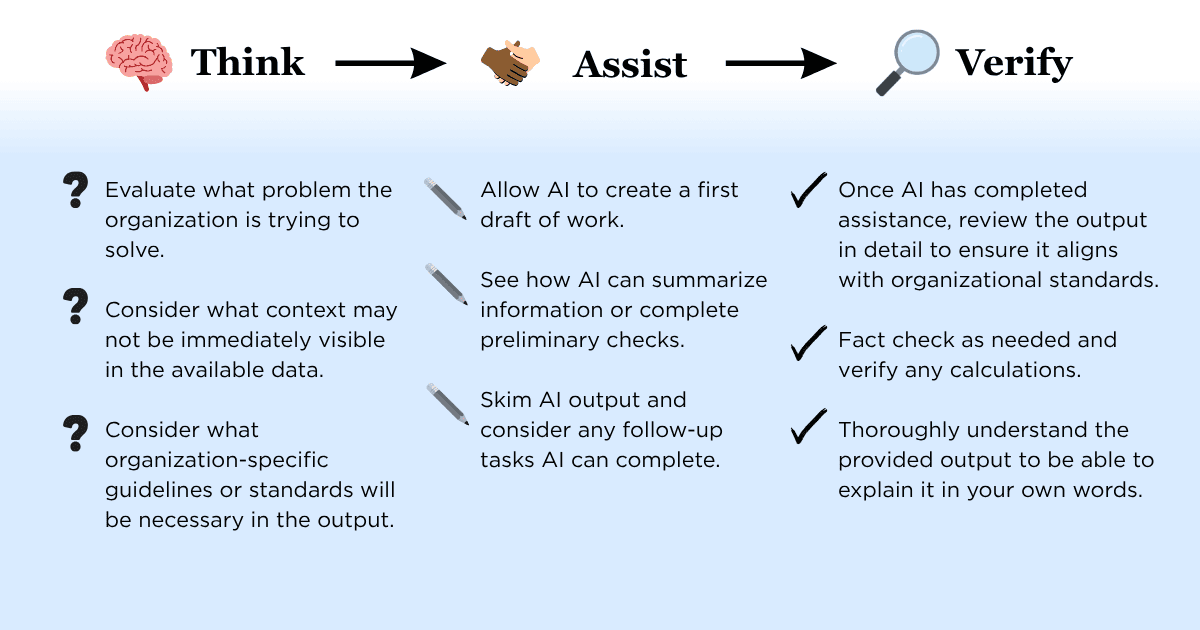
To start, employees identify the objective, share their observations, and consider the problem themselves. AI can then organize information, explore alternatives, prepare an initial draft, or conduct a preliminary review. Finally, a knowledgeable person evaluates the result, verifies important claims, and remains accountable for the finished work.
The appropriate level of oversight will depend on the task. For instance, brainstorming an internal outline carries different consequences from preparing a financial analysis, customer proposal, legal document, or production system. Because of this, leaders need governance that considers risk, not simply an employee’s job title.
AI can help an organization produce more, but volume alone does not create a competitive advantage.
That advantage will continue to come from employees who understand the organization, recognize worthwhile problems, and contribute ideas competitors have not already considered. AI should give those employees more capacity to think—not remove thinking from their work.
Over the next week, we will explore why original thought becomes more valuable as AI capabilities grow, how different business functions can use AI without surrendering professional judgment, and how leaders can prevent unhealthy AI dependency across the workplace. We will also delve into how professionals such as consultants, project managers, and admin assistants can incorporate AI into their roles effectively.
This is the introduction to an ongoing series. You can review the next parts below:
Think-Assist-Verify — And How It Can Be Your New AI Framework
How to Make AI Accessible in Every Role – Innovate. Integrate. Transform. Run. R3Now dba IITRun
Leadership and AI in the Workplace – Innovate. Integrate. Transform. Run. R3Now dba IITRun
For a contextual understanding of the impacts AI is currently having across organizations and industries, take a look at our previously published articles:
Professional Services: The End of the Billable Hour Pyramid
The AI Industrial Shift: The White Collar Divide Is Spreading
Why Your Workforce Is Your Greatest AI Investment
Addressing Concerns for Local LLMs after the OpenAI Incident




Leave A Comment