

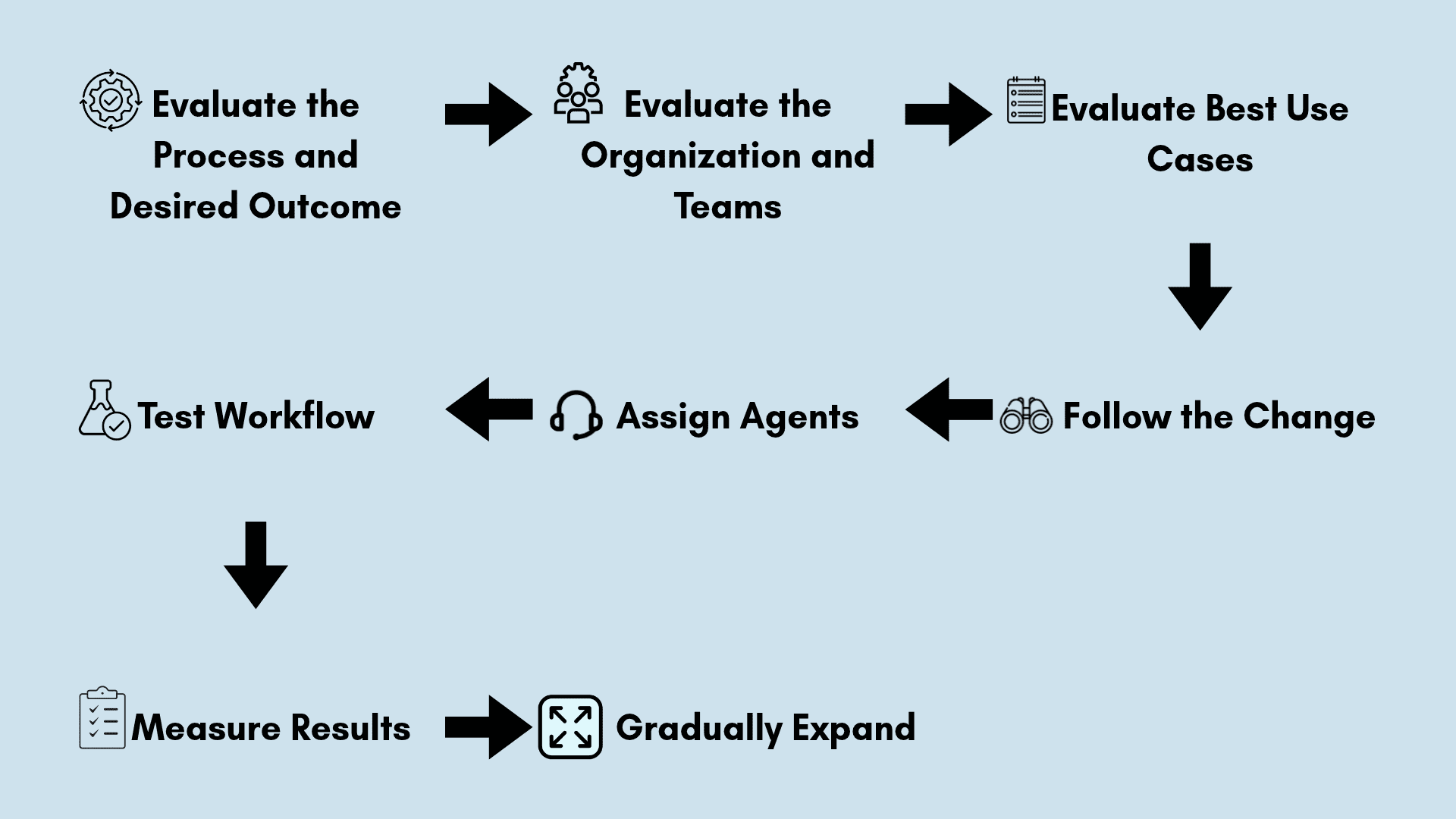
Imagine a manufacturer receiving notice that a component will arrive two days late. A seemingly small change can involve several departments, so the manufacturer needs to have a thorough correction process.
As Artificial Intelligence continues to reshape business operations, the manufacturer may want to incorporate it into their correction process and ERP environment. However, connecting AI to ERP requires decisions about the information it needs, the responsibilities it supports, and the changes it should be permitted to make.
 Start with the Outcome
 Start with the Outcome
Leadership may want to begin with a platform or a broad goal such as “automate purchasing.” However, what does that mean for the employees doing the work?
In our example, buyers might spend considerable time locating supplier confirmations, comparing delivery dates, and asking planners whether a delay will affect production. A more specific goal would be to reduce that investigation time while maintaining production reliability.
Before introducing AI, measure the current process for the following criteria:
- Average length of investigation
- Frequency of corrections
- Approach to missed delays
- Organization of purchasing data
These observations give your organization a starting point for evaluating whether the investment helps.
Understand Where Your Organization Is Today
From there, bring the relevant teams into the discussion. Purchasing may own the purchase order, but planning, manufacturing, finance, and IT each understand different parts of the workflow. Important criteria to evaluate include the following:
- Information employees use (where it comes from and who maintains it)
- Approvals, exceptions, and connections to other systems
- Teams and platforms involved
- Communication protocol
If supplier information is inconsistent or responsibility for an approval is unclear, those concerns need attention. AI will depend on the same business information your employees use. Sometimes, clearer ownership or an existing workflow feature can address the problem before more advanced technology is needed.
Once these requirements are understood, your team can evaluate platforms against the actual process.
Decide Which Part Needs AI
The study A model for incorporating AI into ERP software offers a useful way to break down that assessment. The model separates automation into data acquisition, information analysis, decision making, and action execution.
Applied to our purchasing example, these dimensions might look like the following:
- Data acquisition – Retrieve the purchase order, supplier confirmation, and relevant contract information.
- Information analysis – Compare the dates and flag a possible shortage.
- Decision making – Prepare options for a buyer or planner to review.
- Action execution – Update the record when the required conditions and approvals are satisfied.
Your organization can improve one dimension while retaining human involvement in another. For instance, faster information retrieval may provide meaningful value even if buyers continue approving every change.
 Follow the Change Beyond Purchasing
Now, consider the delayed component:
- Does the manufacturer have enough inventory to continue production?
- Is that material needed for an upcoming order?
- Could the delay affect a customer commitment?
In SAP, material requirements planning (MRP) rescheduling checks compare requirements against existing receipts and can generate rescheduling proposals. Additionally, production orders transferred to SAP Digital Manufacturing support shop-floor execution.
However, changing a purchase order does not automatically move every production order or update every manufacturing execution system. The team will also need to verify configuration, planning runs, order status, and integrations.
With that said, an agent that only sees the purchase order may lack the information needed to assess the consequences. If downstream information is missing or outdated, the recommended approach is to prepare the change and request review.
Give Agents Clear Identity and Responsibilities
Understanding downstream effects helps your organization decide whether a change should proceed. From there, it also needs to establish who can authorize that change and what will perform it.
If an agent updates a purchase order, can your team distinguish that activity from a change the buyer made directly?
To approach this concern, we recommend giving each agent a distinct identity, narrowly defined responsibilities, and a named human owner. This allows the organization to manage its access, review its activity, and suspend its permissions when needed. For instance, a purchasing assistant could retrieve supplier confirmations and prepare delivery date changes without receiving permission to approve exceptions or modify unrelated financial records.
However, an agent’s identity and the authority it uses are separate considerations. Microsoft Entra and Google’s Agent Identity documentation describe agents acting either under their own authority or on behalf of a user. Microsoft can identify the user as the subject and the agent as the actor, while Google documents audit records that show both identities for delegated activity.
With that said, delegated access does not necessarily mean losing visibility into the agent’s involvement. The organization needs to verify whether that distinction remains visible through its connectors and into ERP records. Additionally, acting on behalf of an employee should not automatically give the agent every capability that employee possesses. The permitted activity should remain limited to the task and the applicable business controls.
For our manufacturer, a buyer could request an investigation, an agent could prepare a delivery date change, and a planner could approve an exception after checking production requirements. If the agent then executes the approved update, the resulting records should distinguish each responsibility. The buyer initiated the request, the planner approved it, and the agent performed the change.
 Test the Workflow Before Expanding Authority
Testing should examine whether the purchase order updates correctly, whether the connected systems were affected as expected, and whether the same action can be reconstructed.
The proposed Autonomous ERP Testing Framework Using Multi-Agent Artificial Intelligence describes specialized agents supporting process discovery, test generation and execution, defect analysis, compliance validation, and release assessment. It offers an example of how AI could assist testing, while business and technical teams retain responsibility for verifying readiness.
When testing, organizations should evaluate the following criteria:
- Shortages
- Missing information
- Unauthorized requests
- Duplicate submissions
- Failed integrations
Additionally, the team should check what happens if the underlying record changes after approval.
Similar boundaries apply elsewhere. A life sciences organization, for example, might pilot AI to assemble supplier documentation and flag missing records while quality teams retain disposition decisions.
Measure Results and Take the Next Step
When incorporating Artificial Intelligence, organizations should begin with one defined workflow. Then, the team can compare AI-assisted retrieval and recommendations against their baseline before expanding into prepared changes or limited execution.
Namely, the company should measure time saved alongside errors, rework, review effort, and operational effects:
- Include integration and support costs.
- Establish when execution should be paused or escalated.
- Reassess when the model, permissions, or process changes.
While the investigation process may have initially appeared complex in our purchasing delay example, a proper evaluation simplifies the process and allows AI to further streamline.
In our next article, we will take a deeper dive into agent identity. In the meantime, feel free to take a look at our previously published articles:
AI in the Real World – Enterprise Resource Planning




Leave A Comment