

 As technology continues to advance, many organizations are searching for the best place to begin with AI. For companies in manufacturing, life sciences, agriculture, and other operationally complex industries, the answer may already be sitting inside the business. Years of information related to finance, procurement, production, inventory, supply chain, human resources, and customer activity are often stored within SAP or another enterprise resource planning system.
That information provides a valuable foundation, but the goal should not be to connect the newest AI product to every available dataset. The more important question is which process the organization is trying to improve, and which form of AI is appropriate for the work.
As IBM explains in its overview of AI in ERP, AI can support automation, forecasting, data analysis, and decision-making across ERP processes. Today, we will dive into how to incorporate those capabilities.
Start With the Process Instead of the Product
Before selecting a platform, leadership should identify a costly, slow, repetitive, or decision-intensive process. Where are employees repeatedly transferring information between applications? Which decisions depend on patterns hidden inside years of ERP data? Where do exceptions create delays, rework, or compliance risk?
The answers help determine whether the organization needs natural language processing, robotic process automation, machine learning, generative AI, or a combination. These technologies do not serve the same purpose, even though they are often grouped under the same AI label.
Additional Questions CEOs Should Ask:
- What specific business problem are we trying to solve?
- Does it require NLP, RPA, machine learning, generative AI, or a combination?
- Is the necessary ERP data complete and reliable?
- Does SAP already provide the required capability?
- What advantage would a third-party platform add?
- How will data move between SAP and external systems?
- Who can view information, approve recommendations, and execute transactions?
- How will we detect inaccurate predictions or generated responses?
- Does the integration preserve a clean and maintainable ERP core?
- What measurable operational or financial outcome will determine whether the pilot succeeds?
 Match the Technology to the ERP Process
Although natural language processing, robotic process automation, machine learning, and generative AI can each improve ERP operations, their greatest value may come from working together. The ERP remains the reliable system of record, while the AI and automation layers help employees access its information, interpret patterns, and move approved processes forward.
For instance, natural language processing makes ERP information easier to access. Instead of navigating unfamiliar transaction codes, field names, or reporting structures, an authorized employee could ask for the status of an order, locate a purchase order awaiting approval, or search process documentation in ordinary language. In this role, NLP acts as a bridge between the employee and the ERP system. However, a conversational interface should never become a shortcut around existing controls. The system should only retrieve information the employee is already authorized to view.
On the other hand, robotic process automation is better suited to executing repetitive, rules-based steps within or around the ERP environment. It can transfer invoice information into an SAP workflow, update records across disconnected applications, prepare recurring reports, or route exceptions to the correct team. This can be especially useful when an ERP process also depends on email, spreadsheets, supplier portals, legacy systems, or applications that do not communicate smoothly with one another.
RPA does not necessarily require generative AI. However, combining RPA with other AI capabilities can create what IBM describes as intelligent automation. In this model, AI interprets information and helps determine what should happen, while RPA performs the established steps. For example, natural language processing or optical character recognition could extract invoice details from an email attachment, machine learning could identify an unusual charge, and RPA could enter the validated information into SAP or route the exception for review.
This combination is particularly important because ERP processes include both structured and unstructured information. SAP may contain standardized supplier, inventory, and financial records, while supporting information may arrive through emails, documents, images, or service requests. According to IBM, intelligent document processing can combine RPA, machine learning, and natural language processing to extract, validate, and process information from these less structured sources. In practical terms, this allows the organization to connect information outside the ERP system with the controlled workflow inside it.
Machine learning can then help the organization identify patterns across its historical ERP data. For a manufacturer, equipment, maintenance, production, and inventory records may reveal an increased risk of equipment failure or material shortages. Other applications include demand forecasting, supplier-risk identification, anomaly detection, quality prediction, and cash-flow forecasting. While RPA follows established rules, machine learning can identify relationships that may not be captured by a fixed rule. Because operational conditions and data patterns change, these models should be monitored and periodically reassessed.
Generative AI adds a conversational and interpretive layer across the process. Namely, it can summarize procurement exceptions, explain a financial variance, prepare a support-ticket summary, guide an employee through an unfamiliar SAP process, or draft a supplier communication based on verified ERP information. However, confident language should not be mistaken for verified analysis. Outputs that influence financial, production, quality, regulatory, or employment decisions require visible sources and human review.
Before connecting these technologies, the organization must also understand the existing process. IBM identifies process ambiguity as a challenge to intelligent automation, and recommends process mining and process mapping before implementation. If a process is inconsistent, poorly documented, or filled with unnecessary exceptions, integrating AI may simply automate the confusion. For this reason, ERP and AI integration should begin by improving the process, identifying the appropriate decision points, and determining where employees must remain involved.
Consider SAP Native and Third Party Options
For an SAP environment, native tools may provide closer alignment with existing business data and processes.
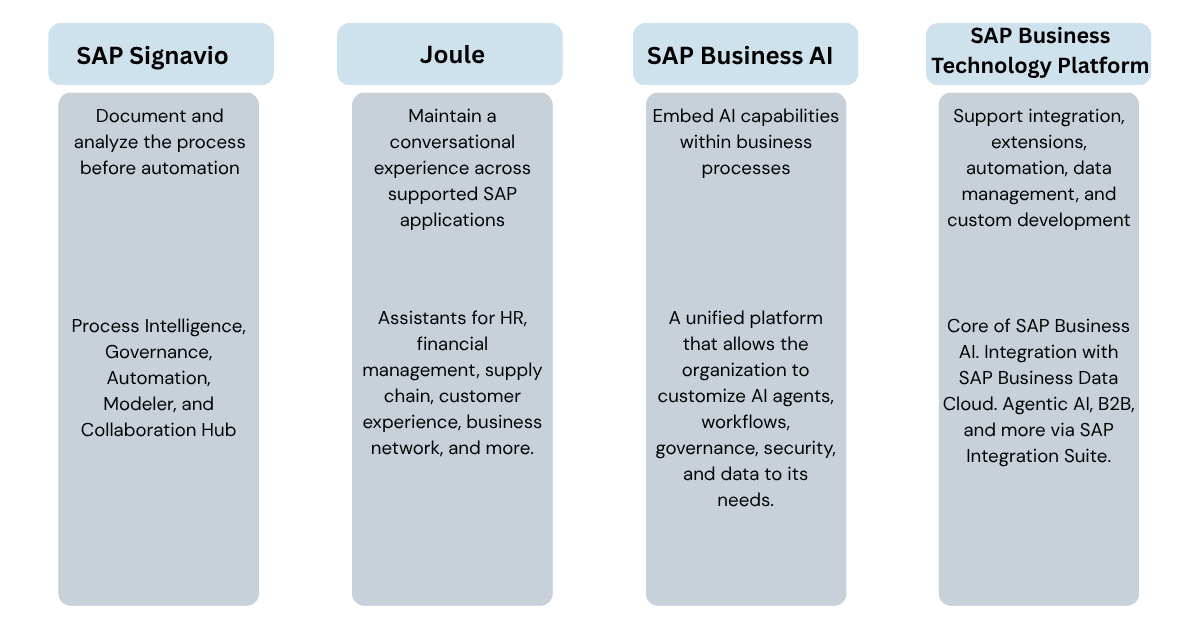
For example, Signavio may help identify delays within procure-to-pay. Machine learning can then uncover patterns associated with those delays. Meanwhile, Joule can help authorized employees ask questions about the process, and automation can complete predictable follow-up steps. Employees remain responsible for exceptions and consequential decisions.
A third-party solution may make more sense when a process spans SAP and several non-SAP applications, when employees primarily work in another productivity platform, or when the business needs an industry-specific model that is not available natively. For instance, tools from Microsoft, UiPath, IBM, and other providers can extend an SAP landscape, but they also add integration, licensing, support, and data-governance responsibilities. The best answer may be native, third-party, or combined. To determine this, the organization should determine which tool best aligns with their process, rather than selecting the product receiving the most attention.
Protect the ERP Core
Connecting AI to ERP data is fundamentally different from using a public chatbot to draft general content. Day to day, an ERP-connected system may encounter financial records, employee information, production data, intellectual property, supplier terms, and regulated documentation. To ensure security, leadership should require role-based access, approved APIs, complete activity logs, clear ownership, and testing for inaccurate or incomplete outputs.
Organizations should also separate information retrieval from transaction execution. For example, a system that summarizes an invoice exception carries less risk than one authorized to approve a payment. After starting with read-only access or recommendations, the organization should add automated actions only after the system demonstrates reliability. This approach supports SAP’s clean core guidance, which emphasizes keeping the ERP environment maintainable while extending capabilities through governed methods.
In Conclusion
Ultimately, AI can help transform an ERP system from a database of transactions into a more accessible, predictive, and responsive operational platform. However, the value does not come from adding AI everywhere. It comes from combining reliable processes, trustworthy data, thoughtful integration, and appropriate human judgment.
Before selecting a solution, leaders should assess their ERP data, process maturity, integration landscape, and governance requirements. This way, the organization can properly fit together both AI and ERP components, and assemble a seamless transformation.
Ready to learn more about how to incorporate AI into your organization? Feel free to take a look at some of our other articles:




Leave A Comment